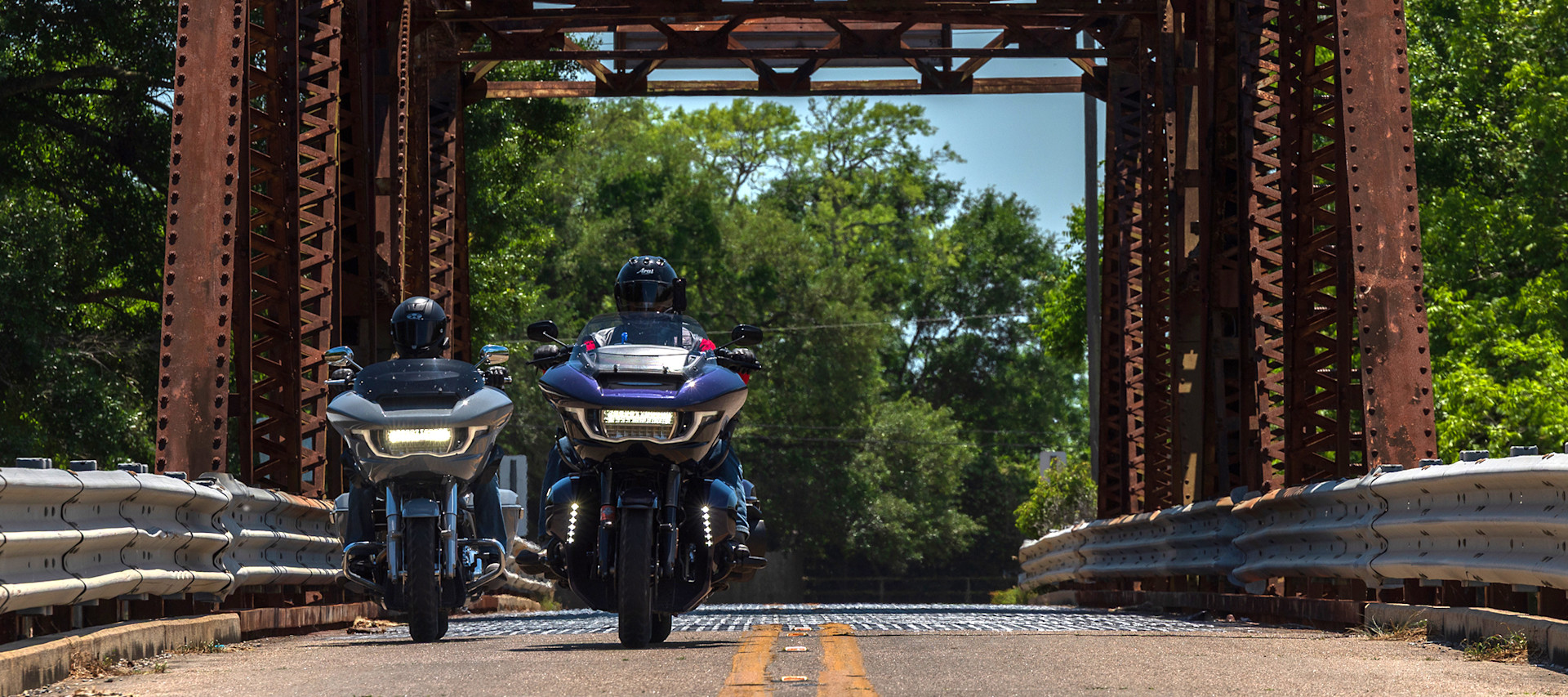
Ten years ago, racing an 800-plus pound touring bike with hard bags and a fairing sounded like a bar bet, not a race series. Now King of the Baggers races headline weekends at Laguna Seca and Daytona, full factory teams from Harley-Davidson and Indian build purpose-tuned race baggers, and the class draws some of the tightest, most physical racing in American motorsports.
Why Baggers, of All Bikes
Part of it is spectacle. Watching a bike built to cruise the interstate get thrown into a corner at a race pace it was never designed for is genuinely wild to watch. The bikes move around, the riders work visibly hard, and the margin between heroic and horizontal is small enough to see from the grandstand. Purpose-built race bikes hide their effort; a racing bagger shows you all of it.
But the bigger part is that it is relatable. Almost nobody owns a full-blown superbike. A lot of people own, or want to own, exactly the kind of touring bike that is out there racing. It turns “what if” into an actual race series. When a fairing and saddlebag silhouette you recognize from your own garage sets a lap time that would embarrass plenty of sportbikes, the whole idea of what a bagger is gets bigger.
What It Actually Takes
Getting a bagger race-ready is not bolt-ons and a paint job. Full exhaust systems built for real flow and heat management, suspension that can handle a corner instead of just soaking up a highway seam, and a chassis stiffened and lightened everywhere the rulebook allows. Every part has to earn its place at race pace, which is a much higher bar than it has to clear on the street.
Heat is the quiet war in all of it. A road course keeps a big V-twin at sustained load in a way no highway ever does, and heat is what finds weak welds, marginal mounts, and finishes that were only ever meant to look good on the showroom floor. Add the loads of braking from triple-digit speeds on a bike this heavy and every component is living a harder life than its street twin. That is the filter everything passes through before a race weekend.
What Racing Gives Back to Street Parts
Race development is compressed aging. One weekend of full-throttle heat cycling, curb strikes, and vibration tells you what years of street miles would eventually reveal, which is exactly why manufacturers race in the first place. Design details that survive get kept; everything else gets redesigned before a customer ever sees it. When you read about stepped headers and welded construction in our Redline spec breakdown, you are reading choices that racing pressure-tested.
The layout debates in the class echo street decisions too. The same physics that decide a race bike’s header routing show up in our 2-into-1 vs. 2-into-2 breakdown: torque everywhere versus top-end breathing, and where each choice earns its keep. Racing just runs the experiment louder and faster than the street ever will.
If You Have Never Watched a Race
Bagger racing is unusually easy to get into as a spectator, because the drama is visible. Watch the braking zones, where nearly a half ton of bike and rider has to shed triple-digit speed, and watch how much the riders move to make these machines change direction. You do not need to know the rulebook to see the effort. Catch a King of the Baggers broadcast from a Laguna Seca or Daytona weekend, pick a rider, and you will understand the class before the first lap is over.
Where TAB Fits In
We have supported bagger racing for years, not as a sponsorship logo but because it is the hardest test our exhaust systems and components ever see. A Redline Performance system that survives a full race weekend of heat cycling and wide-open throttle is a system we trust completely on a street bike doing a fraction of that work. Follow our racing calendar and rider updates if you want to see where the parts on your own bike get proven out.