Once you have decided you want a full system, the next decision is header configuration. Our Redline Performance line comes in both 2-into-1 and 2-into-2 layouts, and riders ask us almost daily which one to pick. The honest answer is that both make strong numbers. The right one depends on what you are optimizing for, so here is the long version of the answer we give at the counter.
Why Header Layout Changes Anything at All
An exhaust system is not just a path out; it is a pressure wave instrument. Every time an exhaust valve opens, a pulse travels down the header, and how those pulses from the two cylinders interact affects how well each cylinder empties and refills. Merge the cylinders into one collector and the pulses can help scavenge each other, pulling spent gas out and fresh charge in. Keep them separate and each cylinder gets a shorter, freer path with less shared plumbing. Neither is free; each trades something to get something, which is exactly why both layouts exist.
2-Into-1: Built for Low-End Torque
Merging both cylinders into a single collector and a single muffler concentrates exhaust velocity earlier in the system. On a heavy touring bike that spends most of its life loaded down with a passenger and luggage, that translates into stronger torque off idle and through the midrange, which is where most bagger riding actually happens. Roll-on passes, loaded launches from a stop, and long grades two-up are where a 2-into-1 earns its keep.
It also tends to run a touch quieter and more even than a 2-into-2 setup, since you are only tuning one outlet instead of balancing two. And it is the layout that racing has been proving out for years: when a bagger has to make usable power everywhere on a road course, a single well-designed collector is the common answer. Our bagger racing breakdown covers why that development matters on a street bike.
2-Into-2: Built for Top-End Pull and Presence
Keeping the cylinders separate all the way to twin mufflers reduces backpressure at higher RPM, which favors riders who like to run their bike harder and further into the rev range, or who are chasing a specific stance and sound with dual pipes on both sides. If your riding includes a lot of high-RPM pulls, the 2-into-2 keeps the engine breathing freely right where you spend your time. Worth reading alongside this: our TAB Talks on backpressure, because the phrase gets misused constantly and the physics matter to this exact decision.
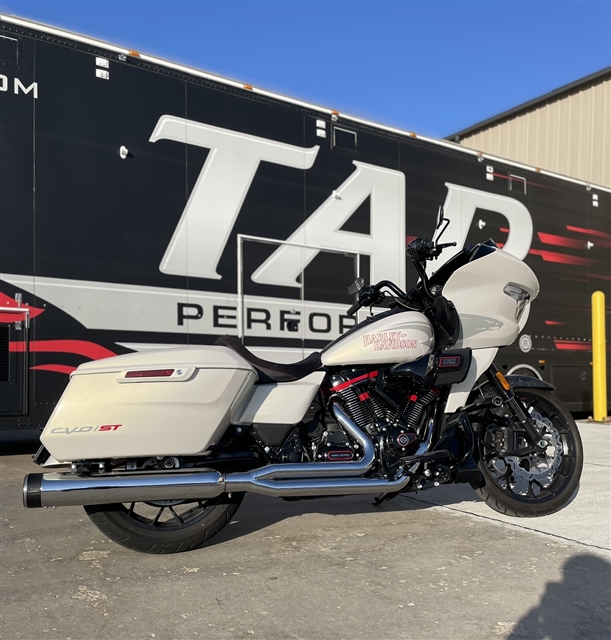
It is also, for a lot of riders, simply the look and the presence they want. Two full-size mufflers on a bagger reads differently than one, and that matters as much as the dyno chart for plenty of customers. Symmetry, chrome or black on both sides, the classic dresser silhouette: if that is the bike in your head, no torque curve argument will replace it, and it should not have to.
Sound, Fitment, and the Things People Forget
Sound differs more in character than in volume. The 2-into-1 concentrates the pulse train into one outlet, which reads as a focused, throaty note. The 2-into-2 spreads it across two, which reads wider and more traditional. Both take our baffle options, so you retain sound tuning either way; the baffle guide covers those choices.
On fitment, remember that saddlebags, lowers, and accessory racks all live near the exhaust path. Both layouts are built to clear stock touring hardware, but if your bike carries aftermarket bags or lowered suspension, mention it when you order so we can flag anything that matters. And plan the install day realistically: a full system swap is a few hours of honest work either way. The step-by-step install guide shows the whole job, and the full spec breakdown covers what ships in the box.
Our Recommendation
If you tour, carry a passenger, or want the strongest roll-on power at legal speeds, start with the 2-into-1. If you ride aggressively, want maximum top-end, or want the visual statement of dual pipes, go 2-into-2. Either way, plan for a tune. A full system without a corresponding fuel adjustment leaves real power on the table and can run lean under load, which is not a compromise worth making on a bike you ride hard.